 Satordle
About Satordle
A daily home for word games.
Satordle is a small home for word games. Every game here starts from the same idea: a handful of letters, a rule about how they connect, and the quiet satisfaction of finding a word that was hiding in plain sight. One fresh board a day, no account needed, nothing to install.
Everything we build stays on that theme. If it is about letters, words and the patterns they make, it belongs here. You can see what we have so far on the Wording Games page.
Where the name comes from
Satordle takes its name from sator, the first word of the Sator Square — a Roman word puzzle that is very likely the oldest word game we still have a copy of.
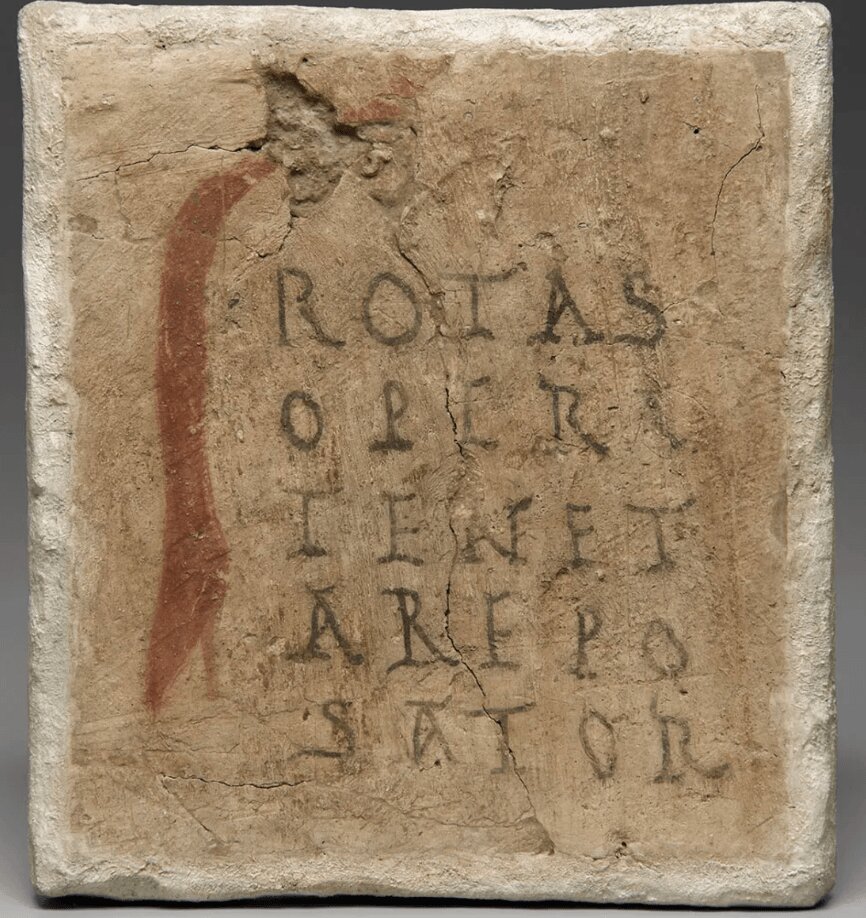
Five Latin words, five letters each. The trick is that the square reads the same four ways: left to right, right to left, top to bottom and bottom to top. Every row is also a column. Getting twenty-five letters to behave like that is hard enough today with a dictionary and a computer — someone did it by hand roughly two thousand years ago.
Because it is symmetrical, the square works whichever corner you start from. Many surviving examples, like the one above, begin with rotas at the top rather than sator — which is why scholars often call it the Rotas-Sator square. Read the same grid from the bottom up and sator comes first. It is the same puzzle either way.
What we know about it
The earliest surviving examples were scratched into walls at Pompeii, so they were made before the eruption of Vesuvius in AD 79. Others have turned up right across the Roman world, from Cirencester in Britain to Dura-Europos in Syria, and later in medieval churches and manuscripts. People kept copying it for centuries.
What it actually means is still argued over. A common reading is something like "the farmer Arepo works his wheels" or "holds his plough with care" — but arepo appears nowhere else in Latin, so it is probably a name invented to make the square work. That is a very word-game thing to do.
There are other theories. The letters can be rearranged into Pater Noster twice, laid out as a cross, with an A and an O left over at each end — read by some as alpha and omega, and so as a hidden Christian message. Others point out that the Pompeii examples are early for that, and treat the square as a charm, a memory aid, or simply a puzzle someone was proud of. Nobody has settled it.
We like the last reading best. Whatever else it was doing, the Sator Square is somebody showing off a very good word puzzle — which is more or less what we are here for.
Get in touch
Found a bug, spotted a word that should count, or want to suggest a game? Write to [email protected].